
Teaching English in Vietnam Legally in 2026: Requirements and Who Fits Where
To teach English in Vietnam legally in 2026, you need a licensed school or center to sponsor you, a role that matches your background, and documents that support a work permit or valid exemption. Vietnam’s current foreign worker rules sit under Decree 219/2025, and working without a valid permit or exemption can lead to a VND 15–25 million fine. The paperwork gets you to the legal starting line, but schools still filter by experience, classroom style, accent expectations, age group, location, and start date.
| The basics | What 2026 actually looks like |
|---|---|
| Legal baseline | Usually a college-level or bachelor's degree, a suitable TEFL/TESOL/CELTA-type teaching certificate, a clean criminal record under 6 months old, a Vietnam medical check, and a licensed sponsoring employer |
| Main legal basis | Decree 219/2025/ND-CP governs the work-permit process. Education-sector rules, including Circular 21/2018/TT-BGDDT for foreign-language centers, affect teacher qualifications |
| Filing route | A single digital submission by the employer through the National Public Service Portal, using integrated Form 03 |
| Decision time | 10 working days on a complete dossier |
| Native vs non-native | Non-native speakers are not blocked by passport alone. Education rules refer to level-5 English proficiency or equivalent; employers often use IELTS 6.5 or TOEFL iBT 100 as the benchmark |
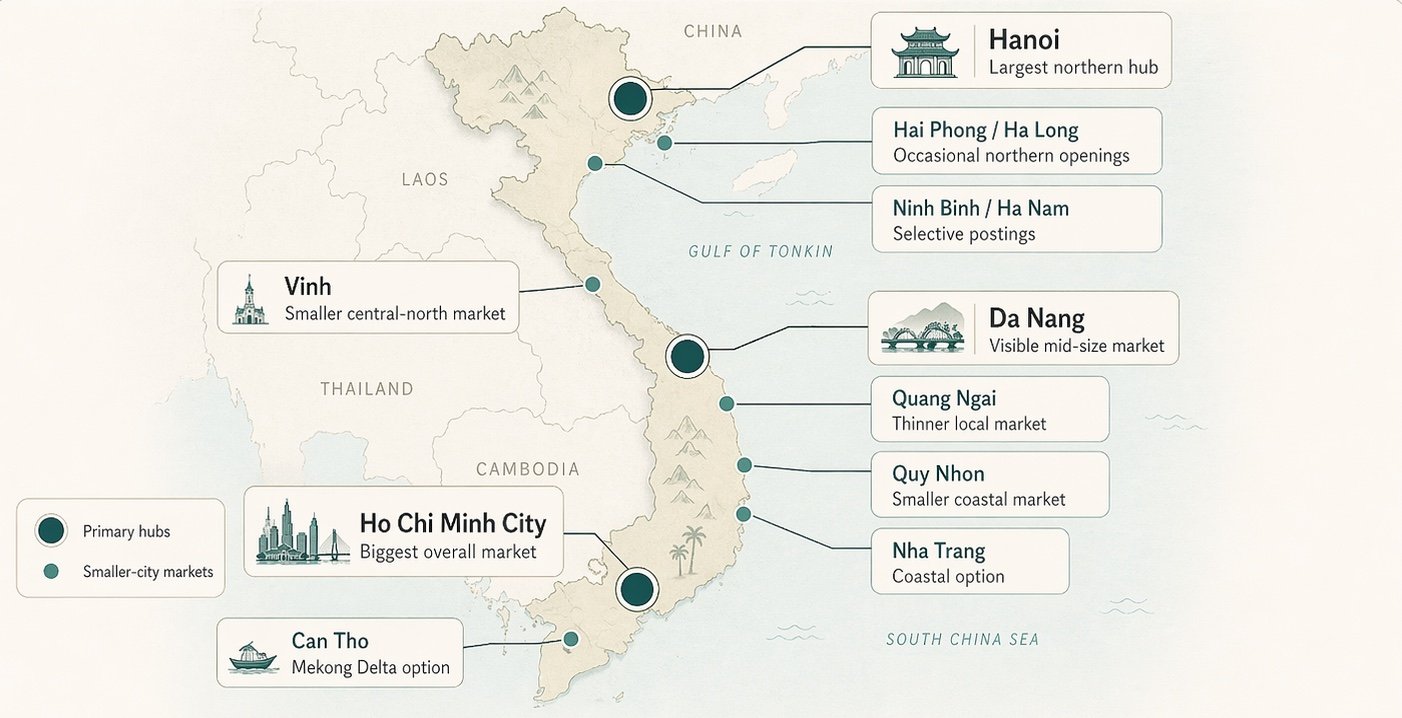
| Volume markets | HCMC and Hanoi for jobs; Da Nang as a middle option; second-tier cities for lower rent but thinner fallback options |
| Pay range | Roughly USD 1,200 to USD 2,000 a month in language centres, higher at bilingual and international schools, with savings of USD 500 to USD 1,200 a month common |
| First mistake to avoid | Starting paid teaching before the work permit or exemption is granted |
Table of Contents
- What it takes legally in 2026: work permits and teaching qualifications
- Who actually gets hired
- Where the jobs are and how the market sorts you
- Which scenario fits which teacher
- What to check before saying yes
- Pay, hours, and the money reality
- Practical tips foreigners commonly report
- Frequently asked questions
Most pages for this search repeat the same five-line checklist and stop. The legal floor is only one layer. What actually decides your year in Vietnam is how the law lines up with your nationality, your documents, and the kind of first job you are willing to accept.
What it takes legally in 2026: work permits and teaching qualifications
Decree 219/2025/ND-CP replaced Decrees 152/2020 and 70/2023 on 7 August 2025. It now governs the work-permit filing. The teaching qualification side also depends on education-sector rules for the school or center hiring you.
For most English-teaching jobs, the legal file has six pieces:
- You are at least 18 years old.
- You hold the degree level required for the teaching role. Many employers still ask for a bachelor's degree.
- You have a suitable TEFL, TESOL, CELTA, or foreign-language teaching certificate. For some work-permit categories, documented experience may also matter.
- You have a criminal record check issued within the last 6 months.
- You hold a medical fitness certificate from an approved Vietnamese hospital, valid 12 months.
- A licensed educational employer in Vietnam is willing to sponsor and file the dossier on your behalf.
The employer submits the application digitally through Vietnam's National Public Service Portal using the integrated Form 03. The official decision time on a complete file is 10 working days. The permit is valid up to 2 years and can be renewed once for another 2 years, giving 4 years total before a fresh application is needed.
For the long-stay routes that follow your work permit, see our short-stay to TRC pathway.
The document side, in order
This is where most teachers underestimate the work:
- Bachelor's degree, apostilled or legalised in the country it was issued, then translated into Vietnamese by a certified translator and notarised.
- TEFL, TESOL, or CELTA certificate. Same legalisation chain.
- Criminal record check, issued within the last 6 months. Foreign-issued checks usually need legalisation and Vietnamese translation; a Vietnam-issued record follows the local process.
- Passport bio page and entry stamps.
- Vietnam medical certificate, done locally after arrival at a clinic approved for foreigner medicals.
- Two recent passport photos to Vietnamese specifications.
- Employer-side documents the school prepares, which you do not handle directly.
Start the legalisation work 6 to 8 weeks before you plan to start teaching. The slowest items are usually the apostille and the criminal record, not the work permit itself.
Non-native speakers: what the law actually asks for
Vietnam's education rules do not restrict English teaching to a fixed list of passports. For non-native English teachers, the rule to check is level-5 English proficiency under Vietnam's six-level framework, or an equivalent certificate, plus the required teaching certificate.
Employers often treat IELTS 6.5, TOEFL iBT 100, or an accepted English-medium degree as evidence for that requirement. Many job ads blur this distinction. Some schools still prefer native-speaker profiles, but qualified non-native teachers can work legally.
Teaching without a degree
Do not build your Vietnam plan around teaching legally without a degree. Some practitioner discussions mention rare cases based on long documented teaching experience, but foreign-language-center standards still point to at least a college-level qualification.
If you do not hold a degree, get written confirmation from a licensed employer before you travel. Online tutoring without a Vietnam employer does not count as Vietnam teaching experience.
Work permit, LD2 visa, and TRC
Once the work permit is approved, your stay route shifts. The LD2 visa is the work-purpose entry visa pegged to the permit. After that, eligible teachers can apply for a temporary residence card (TRC) tied to the same employer, which gives a longer continuous stay without the visa-run cycle. If the work permit file is approved on a degree and certificate that do not match the job title in your contract, the stall point is usually before the LD2 stage. The work permit qualification mismatch guide covers what triggers that.
Who actually gets hired
Legal eligibility and market preference are not the same thing. Schools sort applicants through filters the law itself does not set. Which passport parents prefer to see. Whose accent the centre sells most easily. Who can start on Monday. Who already lives in Vietnam with a usable document set.
A non-native speaker with strong documents and experience often beats a native speaker with weak ones at the same school. The law is the floor. The market is the second filter.
Non-native speakers: where they usually get hired
Filipino, Indian, Pakistani, South African, and other non-native applicants do get hired across Vietnam. Public job posts fall into three patterns: native only, native or near-native preferred, and qualification-led without a passport preference. The third group is where most non-native hires land.
The market tilts in your favour when you can offer one of these:
- Young learner or kindergarten teaching experience with kids under 10.
- IELTS, Cambridge YLE, or another exam-prep specialty with proof you can teach that product.
- A clean document set that lets the school file your permit quickly.
- Willingness to work outside the most crowded districts of HCMC and Hanoi.
- A current legal stay in Vietnam that shortens the school's wait.
The reverse holds too. A non-native applicant with no certificate, no experience, no documents on hand, and a strong preference for adult conversation classes in central HCMC is competing in the hardest part of the market.
What schools still ask for most
Recent listings share the same employer-side checklist:
- Bachelor's degree (any field)
- TEFL, TESOL, CELTA, or equivalent certificate
- Background check
- Passport with workable validity
- Some teaching experience, even when the ad says "preferred"
- Ability to work legally in Vietnam, or readiness to enter the permit process
- A short self-introduction video, increasingly common for centre roles
The video request surprises first-time applicants. It has become routine enough at chain centres that you should expect it.
Where the jobs are and how the market sorts you
Ho Chi Minh City still leads on volume. Hanoi is the second main hub. Da Nang sits in the middle, with a smaller but visible teacher market. Smaller cities have real jobs, but fallback options thin out fast if your first school turns out to be a poor fit.
Big city versus smaller city
Recent 2026 practitioner guides put typical language-centre pay in roughly these ranges:
- Ho Chi Minh City: about USD 1,400 to USD 2,000 per month
- Hanoi: about USD 1,300 to USD 1,900 per month
- Da Nang: about USD 1,200 to USD 1,600 per month
- Second-tier cities: USD 1,000 to USD 1,400, with wider variation
Live listings observed in April 2026 show the texture beneath those averages:
- A District 3 HCMC summer-programme post at 400,000 VND per hour.
- A Tan Binh part-time post at 440,000 to 460,000 VND per hour net.
- Ninh Binh and Ha Nam posts at 500,000 VND per hour part-time, or 30,000,000 VND per month full-time.
- A Vinh-based role reported on a public expat forum at around USD 1,000 net for 80 to 100 teaching hours, with some legal and housing costs left to the teacher.
A high hourly rate paired with thin hours can pay worse than a steady full-time monthly. The number in the ad is rarely the number that lands in your account each month.
What gets advertised most
Kindergarten and young-learner roles dominate public listings. Beyond age group, the recurring patterns are:
- Evening and weekend availability requirements.
- Part-time posts that prefer teachers already in Vietnam.
- Full-time jobs that weigh classroom energy and child management over academic theory.
- IELTS and Cambridge roles asking for evidence of exam-product familiarity.
- Centre jobs requesting a short video before any interview.
New teachers often expect adult or conversation classes. The first serious offer is more likely to be kindergarten, primary, or a kids' class at a language centre.
Which scenario fits which teacher
Teachers arrive with very different documents, passports, and job expectations. These four scenarios cover the most common routes discussed in Facebook and Expat forums.
Fresh TEFL graduate from a preferred-passport country
You hold a passport from the UK, Ireland, US, Canada, Australia, New Zealand, or South Africa, plus a bachelor's degree and a 120-hour TEFL. This is still the easiest profile for many schools to place.
The realistic first job is a chain centre teaching kids in evenings and weekends, somewhere in HCMC or Hanoi. Pay sits around USD 1,400 to USD 1,800 monthly. The legal route is straightforward when the employer files permits regularly.
Your main risk is accepting a role that looks generous on hourly rate but never delivers enough scheduled hours. Confirm guaranteed weekly hours in writing.
Non-native speaker with strong documents
You hold a degree taught in English, IELTS 6.5 or higher, a 120-hour TEFL, and ideally some classroom experience. Legally you fit Decree 219/2025 with room to spare.
The market is rougher than the law suggests. Some centres still gatekeep on passport. The pragmatic path is to focus on schools that hire qualification-first: smaller language centres, several primary and kindergarten contexts, IELTS-focused outfits, and roles outside the most central districts.
Pay starts lower than the previous scenario, around USD 1,200 to USD 1,600 monthly, and rises with specialty and reputation. The Filipino teacher market in Vietnam in particular has grown noticeably and supports its own recruiter network.
Already in Vietnam, looking to convert legally
You came in on a 45-day or 90-day visa, you are job-hunting, and you would like to convert into a legal teaching setup without leaving.
This works only if a willing employer can complete the work-permit process while your current stay is still valid, and only if your home-country documents are already legalised or can be couriered in fast. Many teachers in this situation end up exiting to a nearby country and re-entering on the LD2 once the permit is approved.
Do not start paid teaching before the work permit or exemption is granted. That can lead to fines, deportation, or future entry problems.
Experienced teacher aiming higher than language centres
You hold a teaching degree or licence, three years of formal classroom experience, and a recognisable exam-prep or international-curriculum background. The legal floor is the same as every other scenario, but your target is above the language-centre median.
International schools generally pay USD 2,000 to USD 3,500 monthly, with housing allowance, flights, and insurance usually packaged in. Top-tier schools with full expat packages can clear six figures a year. Strong IELTS and Cambridge specialist roles at well-regarded centres can reach USD 2,500 monthly. Hiring rounds at this tier run further ahead, 3 to 6 months, and references and demo lessons carry more weight than nationality.
What to check before saying yes
The first useful question is not "how much does it pay?". It is "what does this school actually cover, and what falls on me?"
Ask about:
- Whether the school sponsors the full legal work permit process.
- Which document costs they cover and which fall on you.
- Whether the quoted rate is net or gross.
- How many guaranteed teaching hours you have each week.
- Whether you teach at one site or rotate between campuses.
- Who prepares lesson materials, and how much unpaid prep that implies.
- Whether office hours, demo classes, and travel time are paid.
- When payday is and how late payment is handled.
- Whether the school files permits for foreigners regularly, and roughly how many a year.
The old red flags still hold:
- - Pressure to start paid teaching before the work permit or exemption is granted.
- Vague promises about "sorting the visa later".
- Refusal to explain pay clearly.
- No written contract until your first week.
- Requests for suspicious deposits or recruiter fees.
- High headline hourly rates without a guaranteed weekly schedule.
A few things that feel odd at first but are normal:
- Being asked for a short self-introduction video.
- Being asked whether you already live in Vietnam.
- Being asked about your kindergarten or young-learner comfort.
- Schools preferring candidates whose foreign documents are already legalised.
Pay, hours, and the money reality
Vietnam still works financially for many teachers. The older story of arriving, working a few classes, and saving a fortune is not the right default any more.
Typical pay by institution type
For 2026, pay is easier to compare by institution type than by city alone:
- Public schools: about USD 1,200 to USD 2,000 monthly, with weekday daytime schedules.
- Language centres: about USD 1,200 to USD 2,000 monthly, or roughly USD 18 to USD 28 per hour. Mostly evenings and weekends.
- Bilingual private schools: about USD 1,800 to USD 2,800 monthly, usually with limited benefits.
- International schools (British, American, IB curricula): around USD 2,000 to USD 3,500 monthly, with housing, flights, and insurance packages common. Top-tier expat packages clear six figures a year.
- Universities: usually USD 1,500 to USD 2,200 monthly, with daytime schedules and longer holidays.
- Specialist IELTS, Cambridge, or executive English roles: varies widely, from USD 25 per hour up to full packages above general language-centre rates.
HCMC and Hanoi typically pay 15 to 25 percent more than secondary cities for equivalent work. Most full-time teachers report saving USD 500 to USD 1,200 a month after living costs.
The hidden cost line
Foreign teachers often underestimate the cost of preparing documents and settling in. The work permit is employer-filed, but the surrounding costs are not always reimbursed.
Common out-of-pocket items:
- Document legalisation or apostille fees in your home country.
- Criminal record fees and courier costs.
- Vietnam medical check, usually 1.5 to 3 million VND.
- Translation and notarisation of foreign documents.
- Visa or entry costs the employer does not absorb.
- Temporary housing during the first 2 to 4 weeks. Our hidden costs guide for expats in Vietnam covers what tends to bite.
A 30,000,000 VND monthly contract with steady hours and document reimbursement tends to beat a higher headline hourly rate with thin scheduling. Stability beats the cover number more than newcomers expect.
For a wider read on what a single expat needs to budget, see our Cost of Living in Vietnam 2026 guide.
Practical tips foreigners commonly report
City and district variation
If you want maximum choice, start in HCMC or Hanoi. If you want lower rent and slower pace, second-tier cities can work, but only when the school itself is credible.
Within HCMC, public listings hire across districts from District 3 inward to outer chain-centre networks. "I work in HCMC" can still mean very different evenings depending on whether you teach at one central branch or move between three suburban ones.
In Hanoi, teacher communities still describe the market as strong for candidates with decent credentials. Winter, housing quality, and neighbourhood fit shape day-to-day satisfaction more than newcomers expect.
In smaller cities, the issue is rarely starting pay. It is what happens when one school disappoints and there are no five better ones within commuting distance.
Community-reported problems
A few problems show up repeatedly in public teacher discussions:
- Scheduled hours dropping below what the offer suggested after arrival.
- Split schedules that look manageable on paper and drain you in practice.
- Roles built around kids' classes when the teacher expected adults.
- "Native preferred" used as a marketing filter even when the candidate is otherwise workable.
- Side tutoring demand confused with legal permission to tutor.
- Arriving before documents are ready, then waiting weeks for the legal step.
These patterns shape job-hunt strategy more than starting salary does.

Frequently asked questions
Can non-native speakers legally teach English in Vietnam?
Yes. The legal threshold is qualifications plus proof of English proficiency. For non-native teachers, education rules refer to level-5 English proficiency or equivalent; employers often use IELTS 6.5 or TOEFL iBT 100 as the benchmark. Some schools still prefer native-speaker profiles, but qualified non-native teachers can work legally.
Can Filipino, South African, Indian, or Pakistani teachers get hired legally in Vietnam?
Yes. Current listings show a mix of native-only, near-native preferred, and qualification-led ads. Filipino teachers in particular have a visible market in Vietnam, mostly through specialist recruiters and kindergarten-heavy or bilingual schools.
Do schools usually sponsor the work permit, or do I need one first?
Serious employers sponsor the process. Some part-time ads prefer teachers who already hold a valid work permit or already live in Vietnam, because that reduces the school's filing risk and wait time.
Can I look for a teaching job while in Vietnam on a tourist visa?
Searching is fine. Working is not. Sending CVs is different from teaching a paid class. The work permit or exemption should be granted before paid teaching starts.
What qualifications do schools actually check in practice?
Bachelor's degree and a 120-hour TEFL, TESOL, or CELTA certificate. Kindergartens weigh classroom energy and child-management ability. IELTS and Cambridge roles want evidence you can teach that specific exam product.
Are kindergarten and young-learner jobs easier to land than IELTS, adult, or international-school jobs?
In volume terms, yes. There are simply more of them. They are not easier to do well. They are easier to find.
How much do part-time and full-time English teachers usually earn in Vietnam?
Part-time language-centre work pays 400,000 to 500,000 VND per hour at most current posts. Full-time language-centre roles sit around USD 1,200 to USD 2,000 monthly. International schools, specialist exam roles, and senior positions clear those ranges, usually with packaged benefits.
Is private tutoring legal if my work permit is tied to a school?
Not automatically. Private tutoring is common in practice, but your school-sponsored work permit may not cover it. Treat side tutoring as separate work and check before accepting students.
Which cities have the most teaching jobs, and which suit saving money?
HCMC and Hanoi lead on volume. Smaller cities can leave more room in your budget when the job itself is steady and the school is credible. They are weaker when you need several fallback options nearby.
Can I change from one teaching employer to another without leaving Vietnam?
Sometimes, with planning. It is closer to ending one sponsorship and starting another while keeping your documents and stay in sync than a casual transfer. Timing the work permit handover with the LD2 or TRC validity is where most teachers get stuck.
Figures and rules reflect Decree 219/2025/ND-CP, education-sector teacher standards, and live listings observed up to April 2026. Verify exact figures before acting on a specific offer.
Key sources
- Vietnam Teaching Jobs, "Vietnam Decree 219/2025/NĐ-CP: New Teaching Regulations for Foreign Teachers" (2025).
- Ministry of Education and Training: Circular 21/2018/TT-BGDDT on foreign-language and informatics centers.
- Vietnam Teaching Jobs, "The Average Salary for Teaching English in Vietnam: 2026 Comprehensive Guide."
- Public expat and teacher community discussions on Reddit, Expat.com, and country-specific Facebook teacher groups, observed up to April 2026.
Read Next
- How Foreigners With a TRC Apply for a Criminal Record Certificate in Vietnam
- Can Foreigners Buy an Apartment in Vietnam? What the Process Actually Looks Like
- Vietnam Banking for Foreigners: How to Open an Account and What Each Visa Type Gets You
- Working Remotely from Vietnam: Digital Nomad Visa, Work Permits, and the E-Visa Reality
- School Options for Expat Children in Vietnam: What Every Family Needs to Know