
How Foreign Spouses Convert to a Vietnam TT Visa and Apply for a TT TRC
A foreigner married to a Vietnamese citizen who wants to live legally in Vietnam long-term usually needs a TT Visa before applying for a TT TRC (Temporary Residence Card). If you are already in Vietnam on an e-visa, tourist visa, or another non-TT status, the usual sequence is: make sure your marriage proof is usable in Vietnam, convert to a TT visa, then apply for the TT TRC.
The TT visa matters because it gives immigration the correct family-based visa category for the later TRC. A tourist visa or e-visa may let you enter Vietnam, but it does not by itself support a spouse TRC application. The TRC can then grant up to three years of continuous residence without visa extensions or border runs.
E-visa or tourist status to TT TRC
- Confirm that your marriage certificate or proof of relationship is usable for Vietnamese immigration. If you got married here and your marriage was registered in Vietnam, the Vietnamese marriage certificate is usually the simplest document to use.
- Vietnamese spouse sponsors the TT visa conversion using the Form NA5 for inside-Vietnam conversion
- Receive the TT visa, often within about 5 working days from a complete accepted dossier
- Complete temporary residence registration (khai báo tạm trú) for the foreign spouse
- Vietnamese spouse submits the TT TRC application online through the Ministry of Public Security public service portal
- Track the submission email. If the file is cancelled, fix the issue and submit a new application
- Fee notification arrives. Pay the fee online, then attend the appointment to verify originals and submit the passport
- Wait for official notification before collecting the passport and TT TRC
In This Guide
Who This Is For
This article is mainly for foreign nationals already married to Vietnamese citizens who are in Vietnam on an e-visa, tourist visa, 5-year visa exemption, or another non-TT status and want a more stable long-term stay. It is especially useful if you have heard that a spouse TRC can allow up to three years of residence, but you are not sure why immigration asks for a TT visa first.
It is not for foreigners applying for LD work-based TRCs, DT investor TRCs, student visas, diplomatic status, or people who are not yet legally married to a Vietnamese citizen.
Start Here: Which Situation Are You In?
The correct starting point depends on your marriage document and current Vietnam status. In every case, the order is the same: make the marriage proof usable first, move into TT status second, then apply for the TT TRC.
- You are already married in Vietnam. This is usually the cleanest case. Your Vietnamese marriage certificate can support the TT visa conversion.
- You married outside Vietnam. First, make the foreign marriage certificate usable in Vietnam through legalisation, Vietnamese translation, and notarisation.
- You are not married yet but plan to marry in Vietnam. You cannot use the TT route only because you plan to marry a Vietnamese citizen. Enter Vietnam legally first, complete the marriage registration, then start the TT route.
- You are outside Vietnam and already married to a Vietnamese citizen. Your Vietnamese spouse can prepare sponsorship documents in Vietnam so you can enter on a TT visa directly. That is a different starting route from the inside-Vietnam conversion process covered here.
- You are already in Vietnam on an e-visa, tourist visa, or 5-year visa exemption. This is the main situation covered in this guide. Your next step is usually converting to a TT visa before applying for the TT TRC.
What a TT Visa Is and Why It Comes Before the TT TRC
In the Vietnamese immigration system, "TT" is the symbol for Thăm Thân, usually translated as visiting relatives or family visit. In spouse cases, it is used when a foreigner is legally married to a Vietnamese citizen and the Vietnamese spouse sponsors the stay.
It is not a fiancé visa. It is not issued only because two people plan to marry or live together. For spouse cases, immigration needs proof of the legal family relationship, usually a marriage certificate.
The TT visa matters because a TRC is not issued from any visa category. The TRC category follows the visa category behind the application. For a spouse of a Vietnamese citizen, the correct category is TT.
That is why the TT visa sits between the marriage proof and the TT TRC. The marriage certificate proves the relationship. The TT visa puts the stay into the correct family-based immigration category. The TT TRC then gives the longer residence period.
Immigration practitioners are reporting in early 2026 that offices are processing TRC applications mainly for holders of TT family visas and LD2 work visas. The underlying law still lists a broader set of eligible visa categories such as DT investor visa, but applicants outside the TT route should verify the current position directly with the Immigration Department before filing. See our LD2 visa to TRC pathway for more on the LD TRC route.
TT Visa vs the 5-Year Spouse Exemption
Foreign spouses of Vietnamese citizens can also obtain a 5-year visa exemption certificate. It is sometimes presented as a convenient long-stay option. For anyone planning continuous residence, it does not replace the TT TRC route.
| TT Visa → TT TRC | 5-Year Spouse Exemption | |
|---|---|---|
| Supports TT TRC application | Yes, after the TT visa is issued | No, it normally still needs conversion first |
| Maximum continuous stay | Up to 3 years with the TT TRC | Usually 6 months per entry |
| Best use | Full-time long-term residence | Visits or extended stays with travel |
| Bank account and daily paperwork | Usually stronger once TRC is issued | More limited; some banks decline |
| Entry/exit pattern | No border runs during TRC validity | Re-entry or extension may be needed |
For anyone building daily life in Vietnam, including housing leases, buying apartment, banking, and health insurance, the TRC is usually the stronger setup. The exemption has real value for people who travel regularly to Vietnam but are not stying here for good.
For anyone building daily life in Vietnam, including housing leases, banking, and , the TRC is usually the stronger setup.
Getting the Marriage Documents Right
The marriage certificate is the document most likely to decide whether the TT route can start. It is needed before the TT visa conversion and again at the TT TRC stage.
Marriage registered in Vietnam is usually the simpler case. Documents produced by the local People’s Committee (UBND) are in Vietnamese, require no external legalisation, and are normally accepted with notarised copies. If you are still at the planning stage and both parties can register locally, this shortens the document chain.
Marriage registered outside Vietnam must be made usable in Vietnam before it can support the TT visa conversion or TRC application. In practice, this usually means:
- Notarisation or certification in the country where the marriage was registered
- Authentication by the relevant national or state authority, if required by that country’s document chain
- Consular legalisation by the Vietnamese Embassy or Consulate
- Vietnamese translation by an authorised translation provider
- Vietnamese notarisation or certification of the translated copy
An apostille alone is not enough for Vietnamese immigration if the document has not completed the Vietnamese consular legalisation and Vietnamese translation chain. A foreign marriage certificate that is only translated, but not legalised for use in Vietnam, can be returned. Therfore, allow time for this before starting the TT visa conversion.
Stage 1: Convert Your Current Visa to a TT Visa
If you are already in Vietnam on an e-visa, tourist visa, 5-year visa exemption, or another non-TT status, the first immigration step is converting your current stay to a TT family visa.
This conversion depends on usable proof of marriage. Immigration needs a Vietnamese marriage certificate, or a foreign marriage certificate that has been legalised, translated, and notarised for use in Vietnam. Once the TT visa is issued, you can move to the TT TRC stage.
Who Submits the TT Visa Conversion?
For spouse cases, the Vietnamese spouse is the sponsor and should lead the file. The foreign spouse provides the original passport, photos, current visa details, and marriage documents, and signs where the form requires.
In practice, many couples attend together or have the Vietnamese spouse handle the submission with the foreign spouse’s passport and documents. Local offices can differ, so confirm whether both spouses need to attend when the file is submitted.
Which Form Is Used: NA5, NA2, or NA3?
For an inside-Vietnam visa conversion, the key form is Form NA5. This is the application form for visa issuance or stay extension for a foreigner already staying in Vietnam.
For a Vietnamese citizen sponsoring a spouse inside Vietnam, practitioner guidance commonly says Form NA5 should be certified by the ward or commune Public Security office where the Vietnamese sponsor’s permanent address is registered.
Do not mix this with the outside-Vietnam entry approval route. Forms such as NA2 and NA3 commonly appear in spouse sponsorship guidance when the foreign spouse is outside Vietnam and the Vietnamese spouse is arranging entry approval before travel. That is a different route from converting an existing visa inside Vietnam.
If your local Immigration Department asks for an additional sponsor form, follow the local checklist. But for the inside-Vietnam conversion route covered here, NA5 is the form you should expect.
Can the TT Visa Conversion Be Submitted Online?
Official public-service information for visa issuance at provincial level lists direct submission, online submission, and public postal-service handling. It also says that if the file is submitted online, the passport and any documents that are not electronically certified may need to be sent to the receiving authority through the public postal service.
In practice, many spouse conversion cases are still handled through direct contact with the local Immigration Department because the file involves a Vietnamese citizen sponsor, marriage documents, ward certification, and the foreigner’s original passport. The safest approach is for the Vietnamese spouse to ask the local Immigration Department how they want the TT conversion file submitted in that province.
Core Documents for the TT Visa Conversion
For a typical inside-Vietnam spouse conversion, prepare:
- Form NA5, with the required certification for a Vietnamese citizen sponsor
- Original passport of the foreign spouse, usually valid for at least 6 months
- Current Vietnam visa or stay evidence, such as e-visa or current entry status
- Passport photos, usually 4×6 cm
- Vietnamese spouse’s CCCD
- Marriage certificate, or legalised and translated foreign marriage certificate
- Temporary residence information, if requested by the local office
- Any local office checklist items, especially where the sponsor’s permanent address and current residence are different
Address verification is now often checked through the national population database and VNeID-linked information rather than a physical household registration book. Still, some offices may ask for extra proof when the spouse’s permanent address, current residence, and application province do not match.
TT Visa Duration
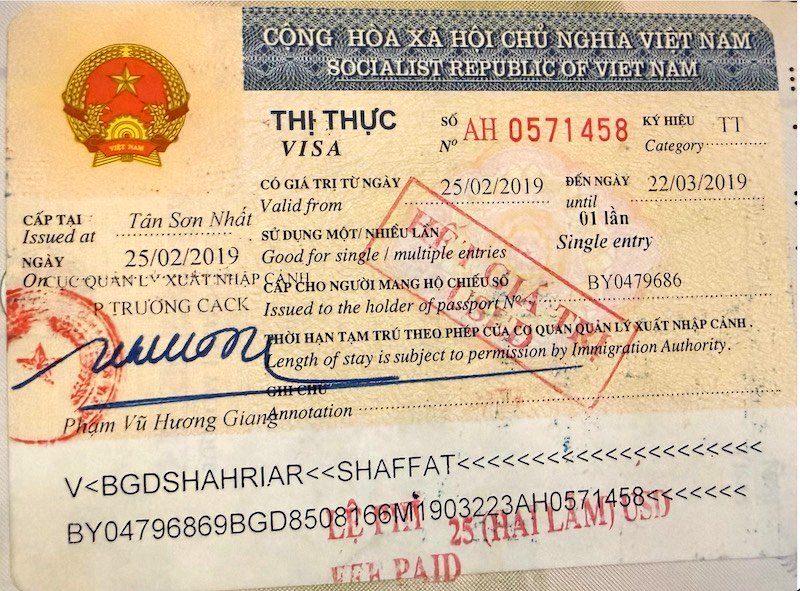
A TT visa can legally be issued for up to 12 months, but the duration granted is case-specific. In first-time spouse cases, applicants and visa practitioners often report shorter grants, such as 3 or 6 months, especially where the office wants more local verification before issuing a TRC. Do not assume you will automatically receive a full 12-month TT visa.
Processing Time and Timing
The TT visa conversion usually takes about 5 working days from the date a complete dossier is accepted. If your existing visa is close to expiry, deal with that before starting the conversion. Overstay penalties apply even if a conversion or TRC application is being prepared.
Stage 2: Applying for the TT TRC
After the TT visa is issued, the TRC application has the correct family-based visa category behind it. This stage is usually handled online first through the Ministry of Public Security public service portal at dichvucong.bocongan.gov.vn.
For this spouse route, make sure you choose the provincial-level procedure: "Cấp thẻ tạm trú cho người nước ngoài tại Việt Nam tại Công an cấp tỉnh". Do not choose the central Immigration Department procedure unless the office specifically tells you to use it.
VNeID: Sort This First
The Vietnamese spouse must have a working Level 2 VNeID account linked to their CCCD before starting the online TRC application. Without it, the portal login does not work.
If the VNeID account is not activated, or if it is linked to an old mobile number, resolve that first at a local police office. Setup is free, but it can take time. Do not leave this to the day of application.
Temporary Residence Declaration: Complete This Before the Online Application
Before opening the TRC application on the portal, complete the foreign spouse’s temporary residence declaration, known as khai báo tạm trú.
This confirms where the foreign spouse is staying in Vietnam. It is usually submitted by the host online at kbtt.xuatnhapcanh.gov.vn. In practice, applicants should not upload only the saved portal PDF if the local police confirmation is still missing. Have the signed or stamped confirmation from the ward police ready to scan into the TRC dossier.
The Vietnamese spouse’s own permanent address is normally pulled from the national population database through VNeID. The old physical sổ hộ khẩu is no longer the standard document, but address mismatches can still create questions at the local level.
Step 1: Vietnamese Spouse Logs In to the Portal
Go to dichvucong.bocongan.gov.vn and log in using the Vietnamese spouse’s VNeID account. Login may use CCCD number and password, or QR scan through the VNeID mobile app, followed by OTP confirmation.
The portal interface is mostly Vietnamese. Couples who are not comfortable with Vietnamese often use help for this step.
Step 2: Locate the TRC Application at the Provincial Police Department
After login, click "Nộp hồ sơ trực tuyến" and search for "Cấp thẻ tạm trú".
You may see more than one TRC procedure. For a spouse TRC handled through the local/provincial route, select:
"Cấp thẻ tạm trú cho người nước ngoài tại Việt Nam tại Công an cấp tỉnh"
This means temporary residence card issuance for foreigners in Vietnam at the provincial police level. Do not select "Cấp thẻ tạm trú cho người nước ngoài tại Cục Quản lý xuất nhập cảnh, Bộ Công an" unless the local office specifically tells you to use the central Immigration Department route.
After choosing the provincial procedure, select the Phòng Quản lý Xuất nhập cảnh for the province or city where the Vietnamese spouse’s sponsorship/residence file will be handled.
Step 3: Complete the Form and Submit the Online Application
The portal form covers:
- foreign applicant’s name, passport number, nationality, current TT visa details, email, and phone
- Vietnamese sponsor’s name, CCCD, and relationship
- processing authority, usually the Phòng Quản lý Xuất nhập cảnh for the relevant province or city
- document uploads
Upload clear scanned copies of the required documents. Upload a 4×6 cm digital photo of the foreign applicant if the portal asks for that format. Make sure every scan is clear, complete, and correctly oriented.
After you submit the online application, the online filing step is complete. The foreign spouse should receive a submission confirmation email from the Public Service Portal. This email includes the application number and a link to track the application status. Follow that tracking link for the next step.
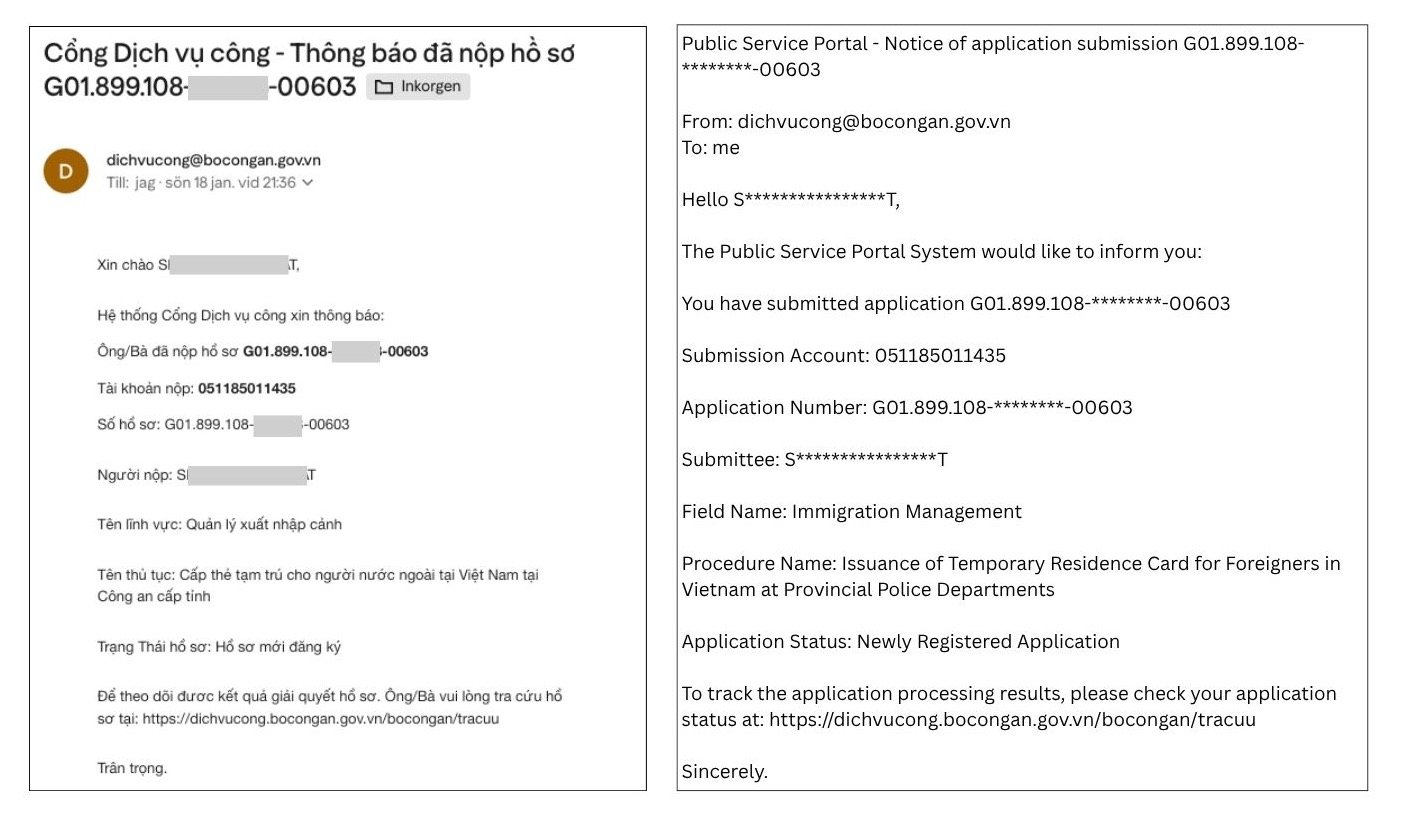
Example of the application submission confirmation email from the Public Service Portal. The English text shown in the image was generated by Google Translate.
Step 4: If the Application Is Cancelled, Fix the Issue and Submit a New File
If the online dossier has a problem, the portal may cancel the application and send an email explaining why. In that case, fix the issue and create a new application. Based on current applicant experience, it may not be possible to simply edit the existing submitted application after cancellation.
A common problem is the temporary residence declaration. For example, if the file only includes a saved PDF from the temporary residence portal but not sealed and signed by the ward-police, the application may be cancelled and the applicant may be told to recreate the file with the confirmed declaration.
After resubmitting, you should receive a new submission confirmation email with a new application number.
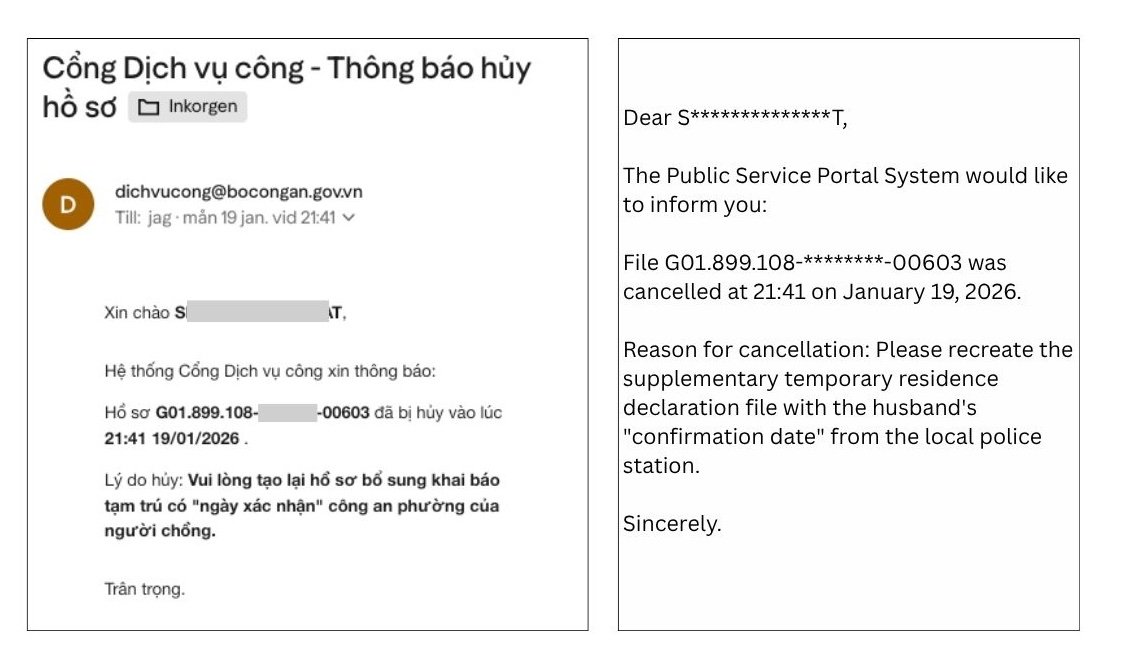
Example of a cancellation notice asking the applicant to recreate the file with a temporary residence declaration showing the local police confirmation date. The English text shown in the image was generated by Google Translate.
Step 5: Fee Payment Notice Arrives
If the application passes the online review stage, the applicant receives a fee payment notification email. This email includes a custom payment link.
The fee amount usually reflects the TRC duration immigration is prepared to issue, not only the duration requested in the application. For example, if you requested a longer TRC but the office decides to issue a shorter card, the fee notice may follow the approved duration.
In applicant reports, this payment notice may arrive within a few days after the accepted online submission, but timing can vary depending on how and where they are reviewing your submission.
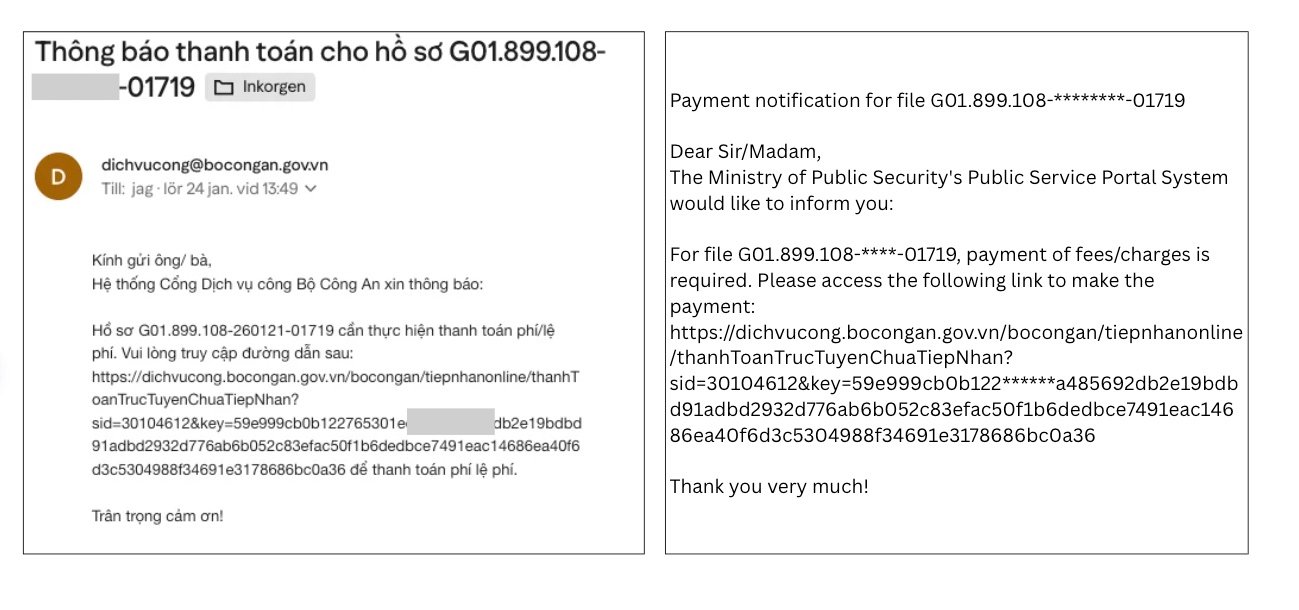
Example of a fee payment notification email with a payment link. The English text shown in the image was generated by Google Translate.
Step 6: Pay the Fee Online
Open the payment link from the email and pay the fee online. Payment may be made through the portal using the available online payment methods.
After payment, save the digital receipt or confirmation. You may need it when attending the immigration office.
Step 7: Attend the Appointment, Verify Originals, and Submit the Passport
After payment, the applicant should receive another email with an appointment date and time to attend the immigration office. In recent applicant cases, the appointment is usually set for about 1 - 2 days after fee payment.
This is the main in-person visit. Both spouses should be ready to attend unless the office tells you otherwise.
At the appointment, the officer may:
- verify the original documents against the online submission
- check that the fee has been paid
- collect the foreign spouse’s passport
- collect the old TRC if this is a fresh application after a previous TRC
- issue a yellow appointment receipt (phiếu hẹn) with a tentative collection date
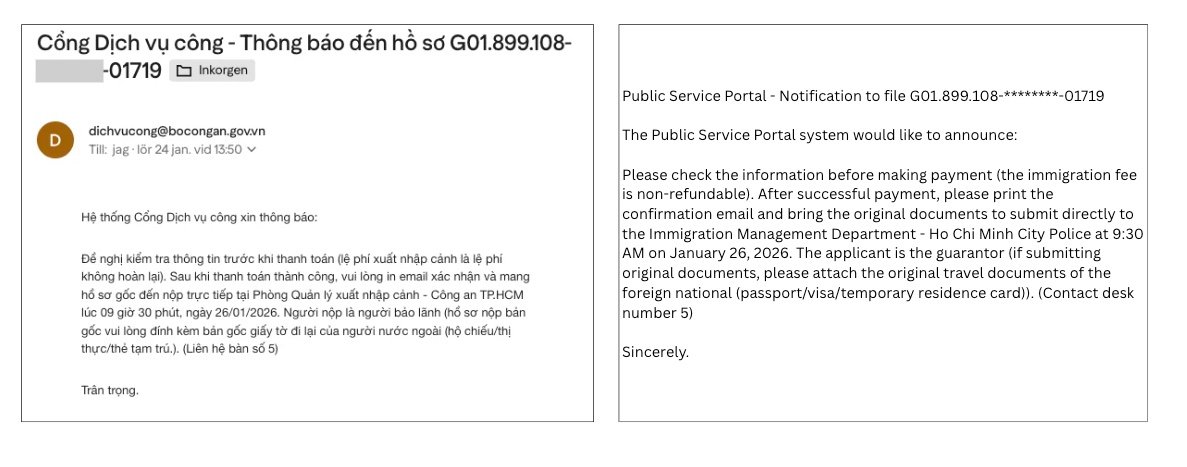
Example of an appointment notice asking the applicant to bring original documents to the Ho Chi Minh City Immigration Management Department. The English text shown in the image was generated by Google Translate.
Step 8: Wait for Official Notification, Then Collect Your TRC
Do not rely only on the date printed on the yellow receipt. Several applicants report arriving on that date and finding the card was not ready.
Wait for the official phone call, SMS, portal update, or office instruction before returning. When you collect the TRC and passport, check the TRC immediately before leaving. Make sure the name, nationality, date of birth, passport number, and validity dates are correct.
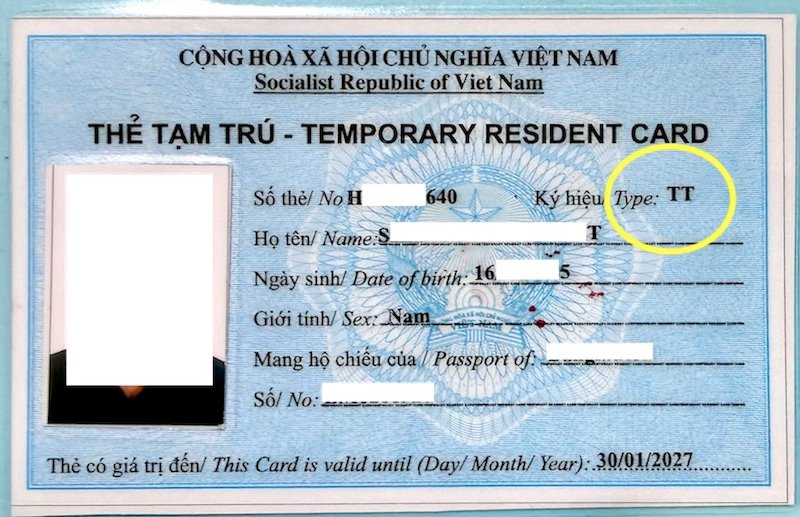
After the TT TRC is in place, you can start handling other Vietnam paperwork for daily life, such as a local criminal record certificate or a converted driver licence.
Required Documents
TT Visa Conversion Documents
| Document | Notes |
|---|---|
| Form NA5 | Main form for inside-Vietnam visa issuance or conversion; usually needs certification linked to the Vietnamese sponsor |
| Foreign spouse’s original passport | Usually needs at least 6 months validity and a blank page |
| Current visa or stay evidence | E-visa, entry stamp, visa exemption, or current stay document |
| Passport photos | Local office may ask for 4×6 cm photos |
| Marriage certificate | Vietnamese certificate, or foreign certificate legalised, translated, and notarised |
| Vietnamese spouse’s CCCD | Used to verify sponsor identity |
| Sponsor address / residence information | May be checked through VNeID and the population database; local offices may ask for extra proof |
| Temporary residence confirmation | May be requested depending on province and file |
TT TRC Documents
| Document | Notes |
|---|---|
| Form NA8 | TRC application declaration completed and signed by the foreign applicant |
| Form NA7 | Sponsorship declaration completed by the Vietnamese spouse |
| 4×6 cm digital photo | Uploaded to the portal if requested |
| Passport bio page | Scanned for upload |
| Original passport | Presented for verification and later submitted when requested; for a useful TRC validity, aim for at least 13 months remaining |
| Valid TT visa | The visa category supporting the TT TRC application |
| Marriage certificate | Same relationship proof used in the TT stage |
| Vietnamese spouse’s CCCD / VNeID information | Uploaded or verified through the portal |
| Khai báo tạm trú confirmation | Temporary residence declaration for the foreign spouse |
| Other local office requests | Province-specific additions are possible |
Processing Time and Costs
TT visa conversion processing time: usually about 5 working days from receipt of a complete accepted dossier.
TT visa duration: legally up to 12 months, but first-time spouse applicants may receive shorter grants, such as 3 or 6 months, depending on file strength and local handling.
TT TRC official processing time: officially 5 working days from the date a complete dossier is accepted. On the ground, the process may involve separate portal notices: submission confirmation, possible cancellation or correction, fee payment notice, appointment notice, passport submission, and final collection. Many applicants report the card arriving closer to 7–10 working days after the file is accepted and the passport is submitted.
If extra checks are needed: the timeline can stretch. Extra verification, returned documents, unclear residence proof, or marriage-document issues can delay the file.
Recommended lead time: if you are still on an e-visa or tourist status, start early. Do not wait until the last week. For foreign marriage certificates, allow 4–6 weeks in total if legalisation and translation are still unfinished.
Official TT TRC fees:
| TRC Duration | Fee |
|---|---|
| Up to 2 years | USD 145 |
| Over 2 years, up to 5 years | USD 155 |
Additional costs to budget for:
- certified translation of foreign documents
- Vietnamese notarisation
- consular legalisation at a Vietnamese Embassy or Consulate
- immigration assistance services or agency, if you choose to use one
Common Problems and What Gets Applications Returned
| Problem | How to Avoid |
|---|---|
| Marriage certificate not usable in Vietnam | Complete legalisation, Vietnamese translation, and notarisation before starting the TT route |
| Wrong starting point | Follow the sequence in this guide: marriage proof, TT visa, then TT TRC |
| Confusing NA2/NA3 with NA5 | Use NA5 for inside-Vietnam conversion unless the local office asks for an additional form |
| VNeID not working | Vietnamese spouse should confirm Level 2 VNeID access before the TRC stage |
| Temporary residence declaration missing or not confirmed | Complete khai báo tạm trú and prepare the signed and stamped confirmation by local police where foreign spouse is residing, before uploading it |
| Passport validity too short | Renew the passport first if the remaining validity is too short for a useful TRC |
| Sponsor address mismatch | Ask the local office how to handle cases where permanent address and current residence differ |
| Poor scan quality | Upload clear, complete, correctly oriented scans |
| Going to collect on the printed receipt date only | Wait for official notification before returning |
| Started too late before visa expiry | Keep legal stay valid throughout the TT conversion and TRC process |
Varies by provincial office: Ho Chi Minh City and Hanoi cases are better documented, but smaller provincial offices may apply additional requirements or formatting preferences. Applicants outside major cities should confirm the current checklist directly with the local Immigration Department.
What Applicants Commonly Experience
Some applicants receive a TT visa first, not the TRC they expected. This is one of the more confusing spouse-residency outcomes. Some applicants say they prepared for a TT TRC but were first issued a TT family visa and told to return later.
This is not a universal rule. Other applicants report receiving a TRC sooner, including cases in Ho Chi Minh City. The safer reading is that document readiness, residence proof, sponsor address, province, and officer handling can all affect the outcome.
You may receive a shorter TT visa than expected. A TT visa can be issued for up to 12 months, but first-time applicants sometimes report 3-month or 6-month grants. Treat the duration as a case-by-case decision.
VNeID is often the first bottleneck. A recurring issue is that the Vietnamese spouse’s VNeID account is not ready when the TRC application begins. Either it was never activated, or the account is linked to an old phone number. Fix this before starting the TRC stage.
The portal is mostly Vietnamese. The public service portal may show some English interface options, but procedure names and application flow are still mainly Vietnamese in practice. Since the Vietnamese spouse logs in and submits the application, working in Vietnamese is the default.
Passport surrender causes anxiety. The period between surrendering the passport and collecting the card can feel open-ended. The yellow receipt is the main document the foreign spouse holds during that period. Plan travel around this.
When documents are clean, processing is usually predictable. Most delays come from marriage-document problems, residence-registration issues, missing sponsor information, poor scans, or extra verification by the local office. If the portal cancels the file, fix the issue and expect to submit a new application rather than editing the old one.
Practical Tips
Ask the Vietnamese spouse to check the local office before filing. Community reports are not consistent. Some cases depend on the spouse’s registered province, current residence, and the office handling the file. Before travelling or filing, the Vietnamese spouse should ask that Immigration Department what they expect.
Do not treat a short TT visa as a failure. If immigration issues a shorter TT visa first, it may still be useful. It keeps your stay legal, gives you time to fix document or residence issues, and may make the later TRC application easier.
Register the marriage in Vietnam where possible. A marriage registered with the local People’s Committee in Vietnam produces Vietnamese-language documents and avoids the foreign-document legalisation chain. This is often simpler than trying to use a foreign marriage certificate later.
Keep your current stay valid while Stage 1 is in progress. If your e-visa or tourist stay is close to expiry, deal with the timing before starting. Allowing the existing stay to lapse while paperwork is in progress creates an overstay problem.
Complete temporary residence registration before touching the TRC portal. Applicants who start the online application without khai báo tạm trú ready often have to pause midway. Do the residence declaration first, then scan the confirmation for the TRC file.
Avoid repeated border runs once the TT route is available. A few exits during a genuine transition period are usually not a problem. But a long record of repeated short-stay exits immediately before a long-term residence application may receive closer attention. Once your TT visa is sorted out, it is better to move toward the TRC instead of relying on repeated exits and re-entries.
Frequently Asked Questions
Who applies for the TT visa conversion: me or my Vietnamese spouse?
The Vietnamese spouse is the sponsor and should lead the file. The foreign spouse provides the passport, current stay evidence, photos, and signatures where required. Some offices may ask both spouses to attend.
Is Form NA2 or NA5 used for the TT visa conversion?
For inside-Vietnam conversion, expect Form NA5. NA2 and NA3 are more common in pre-arrival sponsorship routes when the foreign spouse is outside Vietnam. If the local office asks for an extra sponsor form, follow its checklist.
Do I need to leave Vietnam to convert from e-visa to TT visa?
No, as long as your e-visa is valid through out the conversion process. Applicants report converting inside Vietnam when the marriage documents / proof of relationship are accepted. Local handling varies, so confirm with the Immigration Department before relying on this route.
What if the online TRC application is cancelled?
Fix the issue named in the cancellation email and submit a new application. In current applicant experience, cancelled files may not be editable after submission. A common issue is uploading a temporary residence declaration without the signed or stamped ward-police confirmation.
My marriage was registered outside Vietnam. What extra steps do I need?
A foreign marriage certificate normally needs consular legalisation, Vietnamese translation, and Vietnamese notarisation before it can support the TT visa conversion or TRC application. Do this before starting the TT route.
How long is the TT visa valid?
A TT visa can be issued for up to 12 months, but the actual duration depends on the file. First-time spouse applicants sometimes receive 3 or 6 months first.
Is the 5-year spouse visa exemption better than the TT TRC?
It depends on how you live in Vietnam. The 5-year exemption can be useful for visits and gives more time than a short tourist stay, but it does not replace the TT TRC for full-time residence. For continuous residence, banking, leases, and daily paperwork, the TT TRC is usually stronger.
What happens after my first TT TRC expires?
Vietnam does not treat an expired TRC as a simple extension of the old card. In practice, you prepare a fresh TRC application using the same TRC-stage process. If your TT status is already established, you do not need to repeat the e-visa-to-TT conversion step. The old TRC is collected and a new card is issued after the fresh TRC application is accepted.
Can an immigration service agent submit everything for us?
An agent may help prepare documents, check translations, and guide the portal steps. But they cannot replace the Vietnamese spouse’s sponsor role, VNeID login, or any required personal attendance. Be cautious of anyone claiming they can bypass the process completely. For a first-time TRC application, agent fees can easily exceed USD 500, depending on the scope of help.
Conditions described here reflect spouse TT visa and TT TRC practice as of May 2026. Requirements, portal handling, and local office practice can change without advance notice. Verify the current process directly with the local Immigration Department before filing.
Key Sources
- Ministry of Public Security public service procedure: temporary residence card issuance for foreigners in Vietnam at provincial police level — https://dichvucong.bocongan.gov.vn/bocongan/bothutuc/tthc?matt=52392
- Ministry of Public Security public service procedure: temporary residence card issuance for foreigners at the Immigration Department, Ministry of Public Security — https://dichvucong.bocongan.gov.vn/bocongan/bothutuc/tthc?matt=26285
- Ministry of Public Security Public Services Portal — https://dichvucong.bocongan.gov.vn
- Temporary Residence Declaration Portal — https://kbtt.xuatnhapcanh.gov.vn
- Circular No. 04/2015/TT-BCA and Circular No. 22/2023/TT-BCA, Ministry of Public Security, official forms NA5, NA7, NA8
Read Next
- How to Record a Foreign Marriage in Vietnam: The Ghi Chú Kết Hôn Process
- How to Register a Marriage in Vietnam as a Foreigner: Documents, Process, and What to Expect
- Long-Term Stay Options in Vietnam for Foreigners: Visas, TRC, and the 2026 Route
- How to Drive Legally in Vietnam as a Foreigner? License Conversion and IDP Rules
- Vietnam Work Permit, LD2 Visa, and Labour TRC: From Short-Stay Entry to Residence Card